

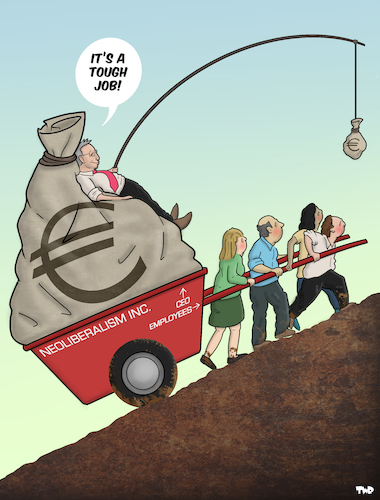
 Despite its misleading name, neoliberalism is not a liberal, progressive, woke, or left-wing ideology. It is a deeply far-right economic policy that aims to benefit the rich, the businesses, and the corporations at the expense of working people. And it has done so wherever it has been implemented, which is in most Western democracies today.
The word liberal itself comes from the Latin liber, meaning free. The “liberal” in neoliberal means freedom from the things that restrict business and greed: from unions, from government regulations, from taxes, from public oversight, from restrictive legislation, from responsibility and from obligation, and it also means freedom for corporations to suppress workers, to pollute, to charge usurious interest. And while neoliberalism is a rightwing policy, it has also been adopted, at least in part, by many liberal and leftwing parties, especially when those parties face a challenging election or have a minority government. Sometimes this has been done to attract (or pacify) corporate and rich donors; othertimes it’s to attract voters. Either way, it’s always bad for the public, for the environment, for the economy, and for democracy. But it’s great for the rich and corporations at the public’s expense.
Neoliberalism has a basket of tools: tax breaks and cuts for the rich and corporations, reduced or eliminated governmental controls and oversight, reduced or eliminated government programs, and anti-union/ anti-worker legislation, tax hikes for mid-lower earners, and service cuts to support programs in order to burden and control the masses. All these are meant to widen the gap between the 1% and the working class, ensure non-interference with corporate functions, and secure laws to keep workers in their place.
Increasing wealth inequality is a core neoliberal platform; poverty is not seen as an ailment to cure, but rather as a condition to exploit and maintain. In the class war that lurks beneath the neoliberal rhetoric about markets, there are only the rich and consumers, only winners and losers. Everything is a transaction with profit as the goal. Greed is seen as a virtue, not a vice. The poor are to blame for their situation; don’t blame corporate greed, rising prices, inflation, stagnant wages, jobs being shipped offshore, bank and credit card interest rates, union-busting legislation, anti-immigration policies… only you are to blame for being poor. (Chomsky wrote that neoliberalism is “basically savage class war.”)
Neoliberalism is often cloaked in a faux religious garment because the masses are susceptible to arguments that appear based on faith. The pseudo-Christian prosperity theology teaches neoliberals that, “Material and especially financial success is seen as an evidence of divine grace or favor and blessings, and the opposite that of judgement” and poverty is evidence that the poor are not loved by their god.*****
Neoliberalism is the stepping stone libertarianism, an ideology that yearns for the end of all government regulations and oversight, and, of course all pro-worker legislation — along with the end of social benefits, programs, and services, community institutions, environmental protection, consumer protection, public broadcasting, public science and cultural agencies, public education, public libraries, public courts, and anything that is not a for-profit operation. Under libertarianism, all public assets and institutions must be privatized; all public services must be marketized and turned into a user-pay system. Without taxation, there are no public services or institutions left.
 Neoliberalism, although sometimes called the ‘invisible doctrine because most of the public seems unaware of what it is, what it does, and how pernicious and ubiquitous it is, has been around for many decades, lurking within the predatory capitalist belief that competition makes the world a better place and is the core characteristic of human beings. Neoliberalism was first launched as a nationwide policy by the dictator Augusto Pinochet, in Chile, 1973, turning “what had been a relatively open and egalitarian society into a laboratory for polarising free-market policies such as privatisation and austerity.” Oligarchs in democracies, as well as other dictators, paid careful attention to Pinochet’s work at destabilizing democracy.
In essence, neoliberalism wants everything to be market-driven and competitive, and, where possible, to dispense with every public asset, service, facility, or institution; any common goals or shared efforts are anathema to it. Neoliberalism values alienation and isolation of the masses over their collective efforts and cooperation. Inequality, especially in wealth and assets, is necessary to maintain this. And wealth inequality today has continued to grow since WWII.
As Tony Judt wrote in Ill Fares the Land (his “critique of contemporary society, exploring the failures of individualism and the need for a renewed social contract,” 2010), “Inequality is corrosive. It rots societies from within. The impact of material differences takes a while to show up: but in due course competition for status and goods increases; people feel a growing sense of superiority (or inferiority) based on their possessions; prejudice towards those on the lower ranks of the social ladder hardens; crime spikes and the pathologies of social disadvantage become ever more marked. The legacy of unregulated wealth creation is bitter indeed.”
Neoliberalism became an openly government-supported ideology in the 1980s under pro-corporation/anti-worker/anti-equality world leaders like Ronald Reagan, Margaret Thatcher, Brian Mulroney, and others. More recently, it was promoted by US presidents George Bush and Donald Trump, Canadian PM Stephen Harper, and UK PM Liz Truss. Canada’s newest PM, Mark Carney, seems to be a neoliberal as well, based on his policies and recent legislation, and his rival, the rage-farming Trump-mimic Pierre PoiLIEvre is definitely one. Ontario Premier Doug Ford is very much a neoliberal, while Alberta’s anti-Canada/pro-MAGA Premier Danielle Smith is clearly a far-right libertarian. Neoliberalism is deeply embedded in international organizations like the WTO, IMF, and in numerous anti-democratic trade tribunals.
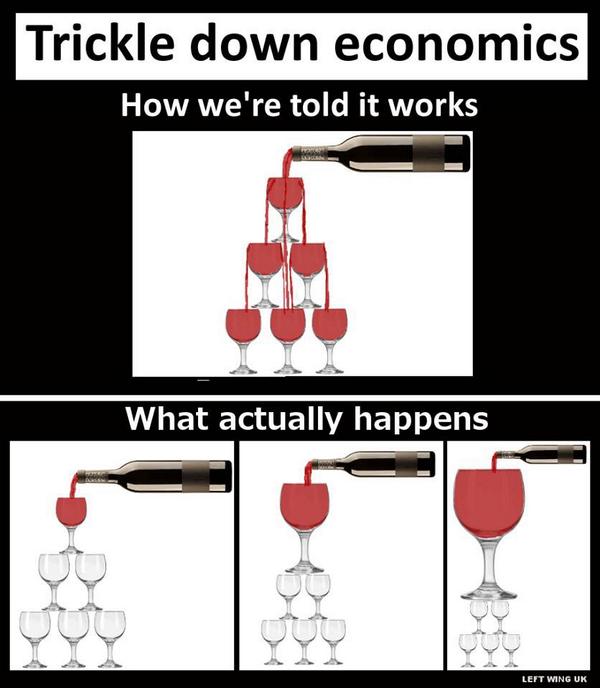 Reaganomics was simply a form of supply-side economics (aka trickle-down economics theory, aka horse and sparrow economics); the notion that if the government helped enrich corporations and the elite, they would use their wealth to create jobs, lower consumer costs, and improve working conditions for the rest. Instead, corporations raised prices and cut jobs in order to distribute dividends to shareholders, and the rich simply accumulated more wealth. Selling ‘trickle-down’ economics to their voters was one of Reagan’s and Thatcher’s most effective con jobs. But Reagan’s neoliberalism went further. As Noam Chomsky wrote, “Reagan’s generosity to the super-rich is of direct relevance today as another bailout is in progress. Reagan quickly lifted the ban on tax havens and other devices to shift the tax burden to the public, and also authorized stock buybacks — a device to inflate stock values and enrich corporate management and the very wealthy (who own most of the stock) while undermining the productive capacity of the enterprise.” *
A study by the London School of Economics of 18 nations over fifty years found that, to no one’s surprise, neoliberal “trickle-down” policies only benefitted the rich (emphasis added):
The rich get richer, while unemployment and economic growth are unaffected. If you cut taxes on the rich…they then bargain more aggressively for their own compensation at the direct expense of workers lower down the income distribution. So, the story of the paper then is really to do with rent-seeking among CEOs and top executives – and that increasing when you have lower taxes on the rich.**
The authors of the study also found that, “The average citizen seems to be fairly poorly informed that taxes on the rich have fallen really dramatically in the past 40 years.” Hence the term, “the invisible doctrine.” Personally, I think the sentence should simply read, “The average citizen seems to be fairly poorly informed.” Re-electing the convicted felon in cognitive decline to the US presidency, the continued support for the felon, and the support for Albertan separation suggest that being well-informed about issues, events, and policies is a rare quality.
In a later interview, Julian Limberg, a co-author of the study and a lecturer in public policy at King’s College London, said (emphasis added),
Based on our research, we would argue that the economic rationale for keeping taxes on the rich low is weak. In fact, if we look back into history, the period with the highest taxes on the rich — the postwar period — was also a period with high economic growth and low unemployment.
But supporters of neoliberal policies warned disingenuously that ‘welfare state’ policies would lead to totalitarianism, socialism, or even communism; that public spending and social services would strip away freedom and rights. Somewhat ironic given that the USA has devolved into a full totalitarian state under the policies of its dictator, Donald Trump. He is not, however, a proper neoliberal, although some of his policies are. Trump is not intelligent enough to have a coherent ideology; he governs by whim, retribution, disorder, and chaos. But I digress.
Neoliberal policies are used to weaken the state, undermine social services and public institutions, so that would-be dictators like Trump and Bolsonaro can get elected by claiming only they can fix things, only to exacerbate the problems and push further anti-democratic, neoliberal policies as soon as they take office. Under their rule, democracy is destabilized, weakened, and even destroyed; a totalitarian regime is erected in its place (seen today in Hungary, the USA, Russia, and previously attempted but failed in Brazil, coming soon to Honduras).
Supporters of neoliberalism — in particular the rich and powerful oligarchs who stand to benefit the most from reduced government intervention — also argue that the government and its bureaucracy are the enemies of the people, and that taxes are an attack on personal freedoms. Ronald Reagan said it in his 1981 inaugural address: ” [G]overnment is not the solution to our problem; government is the problem.” This was the beginning of the long decline in public trust in government institutions and agencies. Reagan’s neoliberalist decay of trust in government led directly to today’s anti-vaxxer movement that illogically distrusts science, medicine, pharmaceuticals, and doctors in favour of pseudoscience and witchcraft, and to the QAnon conspiracy cults that gull the naive and ignorati.
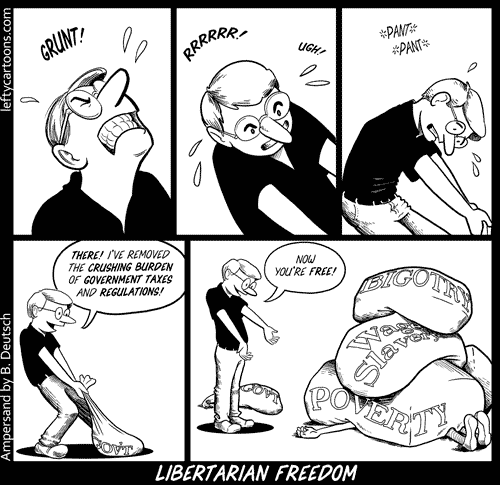 Demanding personal freedom and rights without responsibility or obligation — moral, ethical, or social, and especially not collective — to others has always been the dog-whistle politics of the right, both neoliberals and libertarians. Libertarians just go further and reject providing any form of social support and welfare, regardless of the situation. Empathy is seen as a weakness to be eliminated. It’s a culture of extreme selfishness.****
Libertarians take neoliberalism many steps further to the right. They want a world where, basically, everything is user-pay, markets are free and competitive, and if there is any government left, it is reduced in size, limited in power and scope, and only oversees the military and police roles as “strictly limited to protecting individual rights specifically, life, liberty, and property.” Anything else beyond these limited functions they view as an overreach that threatens personal freedoms. Libertarian governments, such as they would be, would not provide social services, bailouts, safety nets, public facilities or institutions. *****
Oligarchs have spent millions of their wealth to elect useful puppets — most evident in the recent US election, where they bought both Donald Trump and JD Vance their win in exchange for favours later — because “they aim to preserve and expand their economic power. By shaping policies on taxation, regulation, and antitrust, they can protect their vast wealth and ensure their companies remain dominant.” But many oligarchs have embraced even more radical, rightwing and deeply anti-democratic ideologies such as the “New Right,” which.
… seeks to redefine conservatism by blending localism, religious identity, and skepticism of democratic institutions. It opposes abortion, immigration, and globalism while advocating for a society guided by [pseudo-]Christian principles.******
Another extreme form of libertarianism embraced by some of the oligarchs is called Dark Enlightenment (aka neo-reactionary movement, or NRx): “an anti-democratic, anti-egalitarian philosophy founded by Curtis Yarvin, an American software engineer who writes under the pseudonym “Mencius Moldbug.” … This ideology rejects the idea that history progresses toward greater liberty and enlightenment, instead advocating for a return to archaic forms of governance like monarchism or cameralism. It critiques democracy and promotes hierarchical, authoritarian systems.” As Thomas Hartmann writes,
The future of American democracy isn’t being dismantled by accident; it’s being systematically replaced to prepare the way for something entirely new.
A radical ideology known as the Dark Enlightenment is fueling a billionaire-led movement to gut our government, erase democratic norms, and install a technocratic elite in their place.
Trump and Musk aren’t just tearing down institutions—they’re laying the groundwork for an experimental new kind of authoritarian rule…
But this goes way beyond merely making billionaires richer or giving corporations more power over our lives. The audacious experiment Musk has embarked on — which Trump probably doesn’t even understand — involves the fundamental transformation of America from a nation ruled by its own people into one where decisions are made by a very specific elite group of self-selected “genius” white male technocrats.
Andrew Koppelman wrote a piece titled The continuing, destructive power of libertarianism in The Hill in 2022:
Libertarianism has a firm grip — on the Republican Party.
It remains committed to the notion that crippling state capacity will make us freer. Its rhetoric has become more populist. But when Republicans retake power – and they are likely to get at least a share of it in the next election – the campaign for small and weak government will begin anew (with a carveout for abortion, where they aim to take control over women’s reproductive lives). Thus the urgency of understanding the deep flaws of modern libertarian political philosophy.
Essentially, the ultimate libertarian state these oligarchs want to implement would be like the dystopia seen in the Mad Max films: small tribal units overseen by a warlord fighting with other warlords for resources and power.
In the libertarian ideal, tribal power would be held by a single person (an oligarch) or a small, likely family, group. The rest of the tribe would all be indentured servants or slaves dependent on their overlord to provide security, food, housing, and, of course, entertainment. There would be no infrastructure outside the tribal area, no state-funded education or courts, no public services, no social safety nets, no charity aside from what would trickle down from the tribal leader. Without a system of public education, literacy would fall, science, medicine, and technology would collapse back to the Dark Ages or earlier eras. An educated, well-informed public is the enemy of libertarianism (and, indeed, of all rightwing political parties and ideologies).
And this is the world the oligarchs and their rightwing politician puppets are leading us to, today.
Notes:
* From Blogger: “The Horse and Sparrow Economic Theory, often pejoratively termed by critics, serves as a metaphor for trickle-down economics. The imagery evokes a horse fed excessively with oats, where undigested remnants nourish sparrows. Translated economically, it posits that enriching the wealthy (through tax cuts, deregulation) will indirectly benefit lower socioeconomic tiers via job creation, investments, and economic growth. From the Hartmann Report: “… trickle-down wasn’t even a new con. Back in the 1890s, it was called “Horse & Sparrow Economics.” The sales-pitch before the era of cars was that if you fed your horses more oats than they could normally digest they’d pass through all that undigested oat in their manure for the sparrows to pick at; rich people’s excesses would spill over to the average person. It not only didn’t work; it was blamed, in part, for the Panic of 1896.”
** From: Economics for Everyone: A Short Guide to the Economics of Capitalism, second edition, by Jim Stanford (published by Pluto Press, 2015):
Key goals of Neoliberalism:
- Reduce and control inflation; protect the value of financial wealth;
- Restore insecurity and “discipline” to labour markets;
- Eliminate “entitlements”; force families to fend for themselves;
- Roll back and refocus government activities to meet business needs; cut taxes;
- Generally restore the economic and social dominance of private business and wealth;
- Claw back expectations; foster a sense of resignation to insecurity and hardship.
Key tools of Neoliberalism:
- Use interest rates aggressively to regulate inflation and control labour markets;
- Privatize and deregulate more industries;
- Provide special freedoms and benefits for the financial industry;
- Reform the governance of corporations so that maximizing shareholder wealth always guides executive decisions;
- Scale back social security programs (especially for working-age adults);
- Restructure labour markets by weakening labour standards, attacking unions, and more;
- Use free-trade agreements to expand markets and constrain government interventions.
*** From the LSE article on the report: “Rent-seeking is the effort to increase one’s share of existing wealth without creating new wealth – rather like a greedy child demanding a bigger slice of the pie so that there’s less left on the plate for everyone else.” Rent, in these uses, refers to unearned income. When a public service is privatized, and the new owner increases rates and fees beyond their actual cost, their profit is called ‘rent.’
**** Libertarians believe (from The Hill):
Libertarians have faith in the free market and believe that there’s little the government can do to pressure businesses or individuals that would be better than the power of the “Invisible Hand.”
That means unrestricted competition among financial institutions as well as the elimination of the Internal Revenue Service, Social Security and income taxes.
The main argument is that social pressure and the free market will convince individuals and companies to donate to charity to help the less fortunate — replacing the need for the government-run social safety-net — or make business decisions to protect the environment in the hopes of being rewarded by the market for those efforts.
And in the free market, companies live and die without the help of the government, so no bailouts.
However, this is hypocritical: expecting “social pressure” to encourage corporations or individuals to act in a moral or ethical manner without some government or legislation to act as leverage or force is the antithesis of neoliberal and libertarian values. And without taxes, how will municipalities pay for infrastructure, libraries, arenas, water treatment, garbage pickup, and all the services a municipality provides? Is it reasonable to expect a billionaire to step up and personally pay for a municipal garbage pickup and disposal system, including employees, equipment, and landfill site(s) in perpetuity? Is it reasonable to expect corporations to provide food, lodging, and medical care for seniors once their social security and government pensions have been eliminated? Wouldn’t that affect shareholder dividends? Is it reasonable to believe nebulous “social pressure” on a for-profit agency will overcome basic human greed?
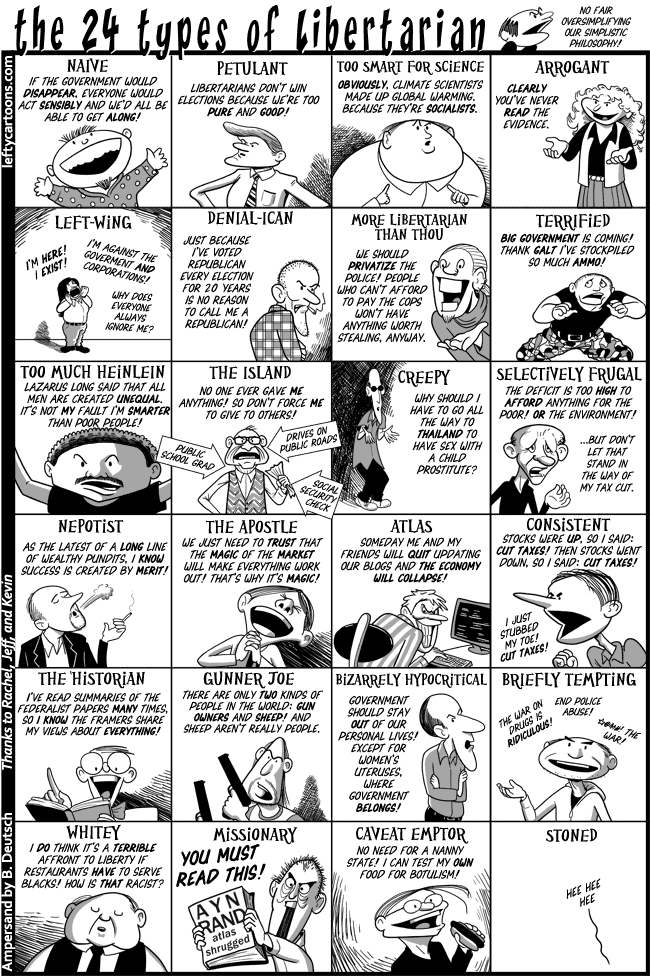 ***** Although there are several and sometimes contradictory and bewildering ideologies that call themselves libertarian, the most commonly associated was espoused by Ayn Rand (author of the raped-girl-decides-she-likes-it novel, The Fountainhead). Some commentators say that form of libertarianism is dead. Jeffrey Tucker wrote for the Brownstone Institute that “There is every bit of evidence that [traditional, Ayn Randian] libertarianism, as a cultural and ideological force, has never been more marginal.” It has been surpassed in recent years by the more aggressive forms of libertarian/anti-democratic ideology mentioned above. Traditional libertarians embraced free trade because they believe in the “invisible hand” of a free market, but the Trump administration rejected it because they could use trade wars and arbitrary tariffs as weapons to coerce and subdue other nations.
****** The pseudo-Christian movement (aka the Talibangelists, aka Christofascists, aka Christian Nationalists) is not about faith or even Christianity. It is about power, money, and controlling others. Its adherents never quote the Beatitudes or chapters like Matthew 25 (“For I was hungry and you gave me something to eat, I was thirsty and you gave me something to drink, I was a stranger and you invited me in, I needed clothes and you clothed me, I was sick and you looked after me, I was in prison and you came to visit me.”) or Leviticus 19 (33 When a foreigner resides among you in your land, do not mistreat them. 34 The foreigner residing among you must be treated as your native-born. Love them as yourself, for you were foreigners in Egypt.) I guess the pseudo-Christians like Kristi Noem and Stephen Miller haven’t read that far into their favourite book… No, they cherry-pick only verses that justify their hatred, their greed, and their oppression of others.
Words: 3,367


https://anneapplebaum.substack.com/p/the-coming-crypto-election
The Coming Crypto Election
How Crypto Is Used for Political Corruption
The crypto industry wants more than just deregulation. They want digital currencies to become part of America’s strategic reserve. They want crypto criminals pardoned.
For that reason, Molly told me, they played a huge role in the 2024 election:
We saw the involvement of these massive, single-issue pro-cryptocurrency super PACs that were getting heavily involved in congressional elections. The industry contributed over $150 million to those super PACs. They spent around $130 million influencing congressional races, where they were hoping to either install pro-crypto candidates or remove people who were viewed to be enemies of the crypto industry. At one point it was almost half of all corporate spending was coming out of the cryptocurrency industry.
You can expect more of this in the midterms:
We’ve already seen these same crypto PACs from 2024 raising money for the 2026 elections. We’re actually seeing new super PACs being established. One of them has already committed to spending $100 million in the midterms. And we’re seeing politicians and candidates speaking very frankly about wanting to install pro-crypto candidates.
As I argued in episode one, don’t just look at the Trump administration’s tactics, look at the longer strategy. And keep asking: how will these authoritarian tactics be used to shape elections?
https://www.publicnotice.co/p/trump-healthcare-plan
Trump’s long-awaited healthcare “plan” is a joke
He can barely bring himself to pretend he cares.
This is the ultimate expression of a foundational Republican belief about healthcare, which is that if we could only inject more free-market magic into the system, all the problems that bedevil it would disappear.