

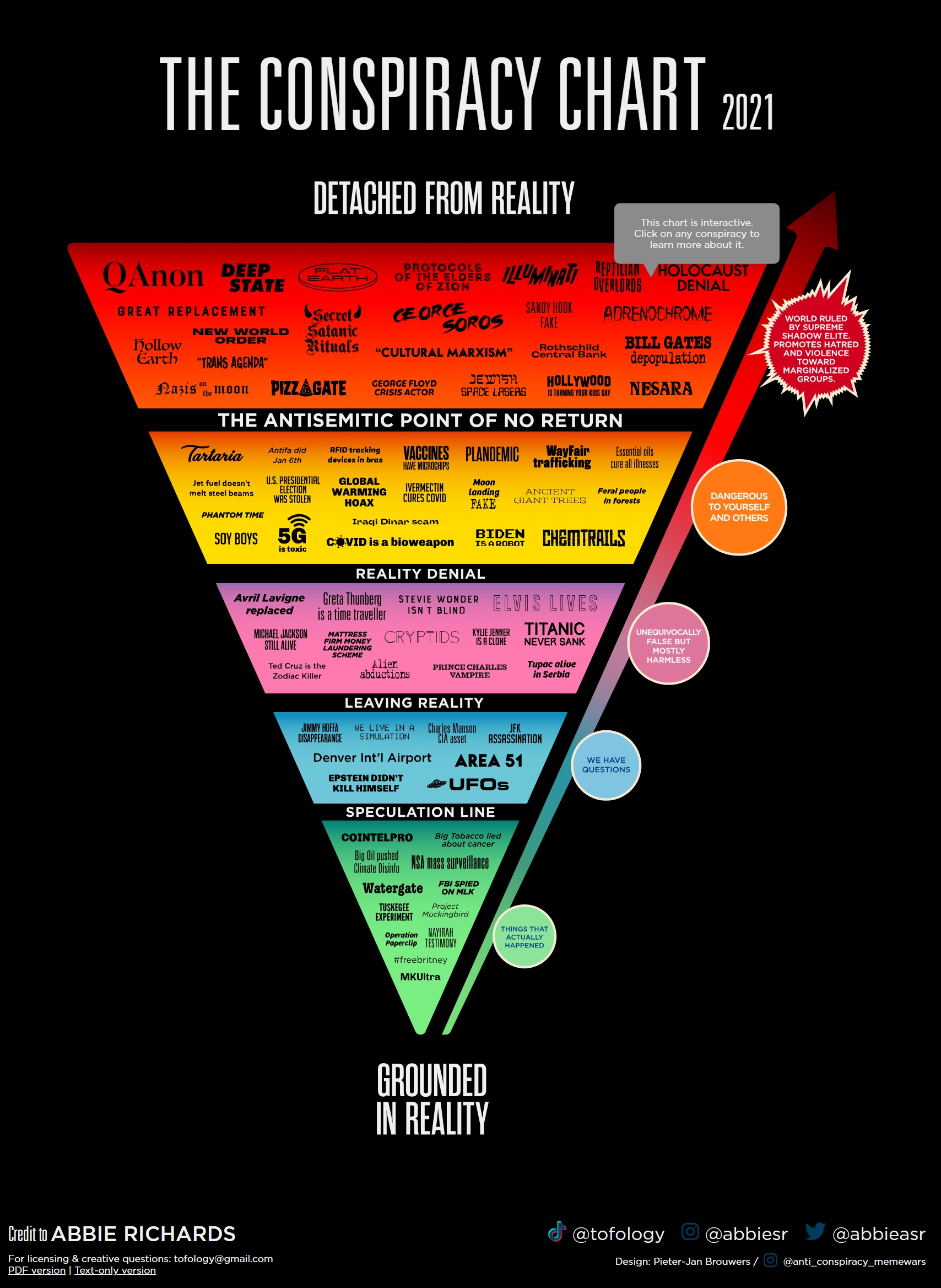
 In his book, The Story of Stories: The Million-Year History of a Uniquely Human Art, author Kevin Ashton dedicates a chapter to how conspiracy “theories” have come to dominate the public narrative on many levels. And in doing so, these conspiracy stories, as Ashton calls them, have negatively affected almost everything from politics to public discourse to health to school curricula to religious beliefs, and even to family relations.
But, he cautions, despite the popular and media use of the term, none of these are actual theories. Instead, he calls them conspiracy stories. Because, after all, they are really no different in their realism and adherence to facts from any fiction novel or comic book, aside from how they are disseminated and shared.*
For many years, I, too, have railed against the use of the word “theories” in describing what are at best misunderstandings and simplistic views of events, activities, and institutions. At worst (and, sadly, usually), they are fevered dreams, bizarre notions, baseless fantasies, ideological exaggerations, political disinformation campaigns, or demented imaginings. To elevate them to a “theory” suggests that actual research was involved, instead of just highly selective scanning of online influencers and YouTube videos in search of confirmation bias. I’ve long used the term “conspiracy cultists” to describe these people, and their “theories” I simply call “piffle.” I am persuaded by his book to change that to Ashton’s “stories” in future.**
Some of these stories are, of course, deliberate lies and disinformation meant to sway public opinion and damage political opponents. Putin’s Russian troll farms are notorious for spreading these under the guise of fake social media accounts that pretend to be USian patriots. The Mueller Report was chock full of examples of such Russian and other foreign actors working to help elect Trump via disinformation and conspiracies. (If you haven’t read it, you should!) The entire anti-vaxxer campaign was a tsunami of improbable and factually incorrect conspiracy stories, none of them based on science, medicine, or reality, often created by grifters using public ignorance and fear to sell their own products and services (expensive but useless, of course, in preventing or treating COVID).
A surprisingly small number of social media accounts are responsible as originators of disinformation and conspiracy stories. As reported by CTV News in February, 2026, recent research showed “there are only about 100 very active Canadian users who account for nearly 70 per cent of conspiratorial content.”
This demonstrates that conspiratorial claims are driven by a small, highly active and visible subset of social media users who exert a disproportionate influence on the information environment,” stated the report, which was released this week.
Some conspiracy stories are relatively harmless — they may be simply foolish, but can also be created from pseudoscience, mythology, or the supernatural. They are not usually directed at any particular person or group, but instead may be attempts to explain a natural phenomenon without recourse to actual science or evidence. They are often created and sustained through genuine curiosity. Bigfoot, Nessie, Atlantis, Noah’s Ark, and UFOs are among these stories. (Creationism is intellectually harmful, however, because it denies actual evidence and demands religious believers choose risible Bronze-Age mythology over provable science.)
Conspiracy story researcher Abbie Richards calls the speculation line the “point where theories begin to leave reality but have not yet entered a zone where they could pose a major hazard to those who believe in them. This line is crossed when individuals start to deny history, science, and medicine, leading to a detachment from reality.” It’s also the moment when people move from mere interest into obsessive focus, conspiracy story sharing, then embellishing.
Social media is the perfect platform for spreading conspiracy stories because there is little to no moderation to identify factuality or credibility in them. And these platforms reach a very wide range of users, from pre-teens to seniors, with an equally wide range of education and literacy. A blurb for the Conspiracy Kitchen notes:
Belief in conspiracy theories is booming in the 21st century, and our research suggests that age 14 is when many of us may become curious about these intriguing ideas. ***
Not that conspiracies don’t actually happen. They do, as Ashton points out, but the speculation line crossed by amateurs or the ignorati often leads to magical thinking about them, and the conspiracy cultists go down various imaginary rabbit holes in search of answers that satisfy their magical thinking and confirmation bias. That journey usually leads them further and further from any truth. That journey fulfills a basic human need, Ashton argues,
It feels good to believe you know and understand things that other people know and understand, especially in a world where expertise is both valued and difficult to achieve. And, most of all, it feels good to discover the antagonist, explain the unexplained, and solve the mystery, especially if ambiguity makes you uncomfortable.
And it’s not entirely the right-wingers like MAGA and Maple MAGA loyalists who are gulled by conspiracy stories, although they seem to be at the centre of their propagation and their belief (no one ever overestimated the collective IQ of the MAGA movement). But when a notorious Pizzagate conspiracy spreader (and 2020-election-fraud spreader) is appointed as the latest White House press secretary, it’s hard to argue that the political right wing doesn’t dominate their use and dissemination, and clings to the belief in, and the spreading of, conspiracy stories for their own benefit and political gain, even when they have been confronted by the facts that disprove their stories.
Conspiracy stories have a cumulative effect. Once you believe in one, research shows it becomes easier and quicker to believe in others. Once you buy into the nonsense of Pizzagate, or vaccines have microchips, or chemtrails, it becomes much easier to believe that the 2020 election was stolen from Trump, that schools are changing the gender of kids, that climate change is a hoax, that 9/11 was an inside job, or that there’s a war on Christmas. Wikipedia lists dozens of conspiracy stories dating from ancient times to modern times, but new ones are invented almost daily. And believers find correlations among them, even when none are apparent to non-believers.****
For all that, none of these conspiracies is a theory. None is even a hypothesis. But all are stories. And we should refer to them as such. Not as theories.
Notes:
* The Story of Stories, published by Harpercollins, 2026. The section in question is Chapter 7: Death by a Thousand Stories.
** The Oxford English Dictionary (OED) defines conspiracy theory as “the theory that an event or phenomenon occurs as a result of a conspiracy between interested parties; spec. a belief that some covert but influential agency (typically political in motivation and oppressive in intent) is responsible for an unexplained event”. The OED cites the earliest usage as from 1909. According to the Online Etymology Dictionary, the word conspiracy has been around since the 14th century, but the phrase “conspiracy theory” dates from 1937. In 2020, The Conversation published a story titled, There’s a conspiracy theory that the CIA invented the term ‘conspiracy theory’ – here’s why. It noted, “This conspiracy theory claims that the CIA invented the term in 1967 to disqualify those who questioned the official version of John F Kennedy’s assassination and doubted that his killer, Lee Harvey Oswald, had acted alone.” Wikipedia notes there is a separate legal term used by the phrase. Wikipedia says the phrase was first recorded in 1863, and “it was notably invoked in reports following the 1881 shooting of then-President James A. Garfield.” Wikipedia notes (emphasis added), “conspiracist beliefs invariably oppose the mainstream consensus among those people who are qualified to evaluate their accuracy, such as scientists or historians.”
*** From Dr. Daniel Jolley’s website:
My research demonstrates the pervasive societal and psychological impact of conspiracy beliefs. These beliefs have been linked to disengagement from politics, diminished concern about environmental issues, and the erosion of trust in public health initiatives. They are also associated with support for violence and engagement in unethical behaviours. My recent studies have explored how economic hardship fosters feelings of anomie, which heightens belief in conspiracy theories targeting marginalized groups, amplifying anti-immigrant sentiment and societal polarization. I have also demonstrated that conspiracy beliefs can distract from systemic inequalities, reducing the likelihood of social and political change.
**** From a paper in the USian National Library of Medicine, titled, Belief in conspiracy theories: Basic principles of an emerging research domain (emphasis added):
…the single best predictor of belief in one conspiracy theory is belief in a different conspiracy theory. Even beliefs in mutually incompatible conspiracy theories are positively correlated (e.g., Princess Diana was murdered vs. Princess Diana staged her own death). While many conceptually distinct conspiracy theories exist, the tendency to believe in them appears to be underpinned by broader beliefs that support conspiracy theories in general (e.g., beliefs in cover ups). Some scholars argue for a conspiracy mindset as a relatively stable predisposition to believe in conspiracy theories that varies between persons. Despite the high variability in conspiracy theories—involving topics that range from climate change to chronic illnesses to terrorist attacks—research demonstrates that largely similar and predictable psychological processes drive people’s belief in them.
Words: 1,528


- No, It’s NOT a Theory. It’s Just a Story. - 2026-10-15
- Collingwood’s 2026 Municipal Election, Part 4 - 2026-10-12
- The Lifetime Reading Plan - 2026-09-30
