

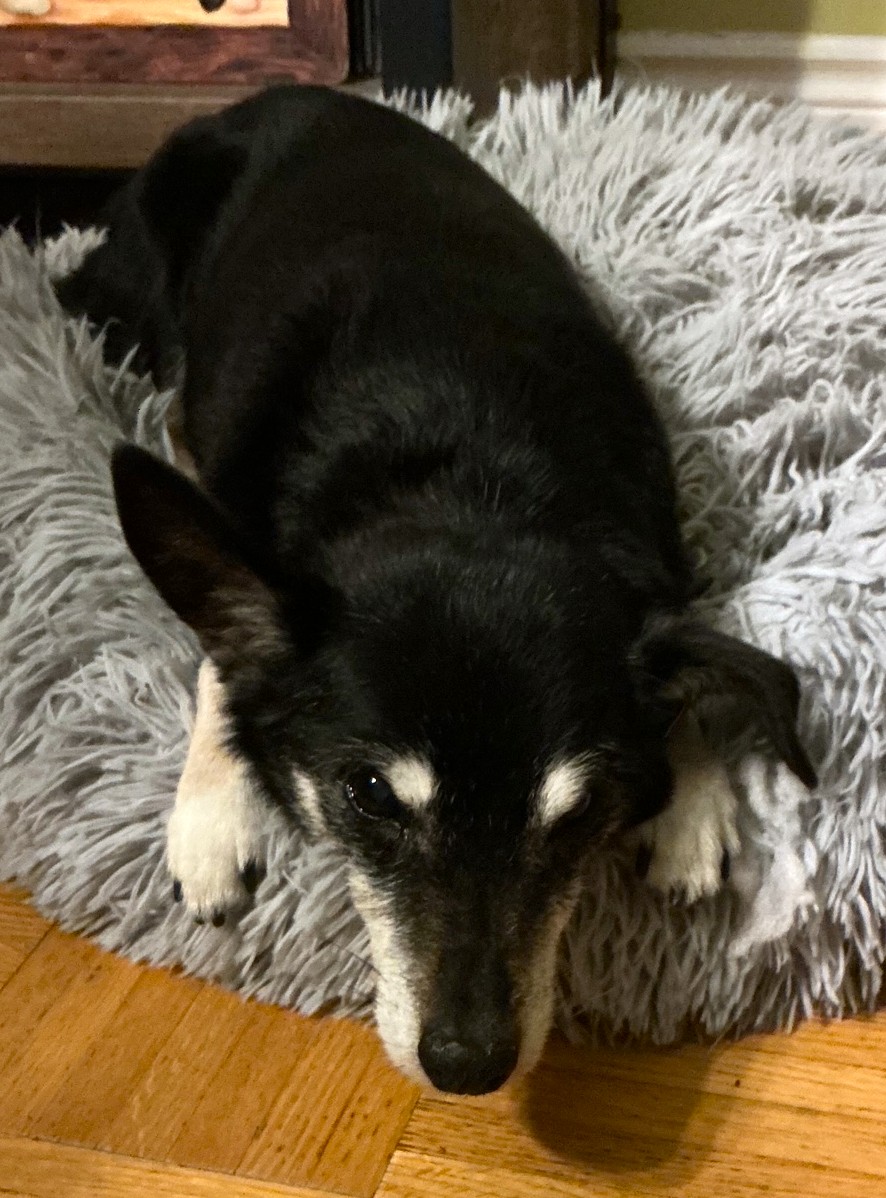
 We got Bella as a rescue dog from the local humane society almost 14 years ago. She was, we were told then, three years old, although there was no exact date of birth given. We were told she was a cross between a Jack Russell terrier and a Chihuahua. She was mostly black, but with a cute mix of tan and white on her muzzle and feet. Now in her 17th year, all that tan has turned to white and only a little of it reminds us.
She has been our constant companion ever since we brought her home. For most of that time, she slept on the bed beside me, sat on the couch between us when we ate or watched TV, played with her box of squeaky toys several times a day, loved to greet people and other dogs on our daily walks, and enjoyed her trips to the local park. She was active, affectionate, good with the cats, and zany. She was smart and understood (and obeyed) commands and gestures. We loved her.
Since I mostly worked from home those years, I was with Bella (and Sophie, our previous dog) throughout the day. We walked around the neighbourhood and local parks several times every day. If I sat on the couch, she would jump up and join me. If I went upstairs, she bounded after me. I could pick her up and scratch her ears, rub her belly, and she liked it. She and I were close. Susan said she was “my” dog.
But in the past two years, she has changed, slowly at first but progressively of late. She stopped playing with her toys, didn’t care when we tried to entice her with one. She stopped chasing sticks we threw. She sleeps a lot more. She stopped barking. She bumps into things in the house as if she cannot see them. She stopped going up and down the stairs, and started sleeping in the dining room on a bed. She didn’t want to sit on the couch with us, didn’t like being cuddled or petted. Her sleep patterns changed, and she slept a lot more than before, often waking in the middle of the night, pacing around the house. We took all of her unused toys to the local dog park and left them there for the other dogs.*
In part, we knew it was because she was growing both deaf and blind. Not fully, but it was evident she could not hear or see as well as in the past, and her disability in both areas has grown. That’s just natural aging, and we tried to accommodate her, making allowances, providing company, comfort, and safety to make her life with us easier. We put out several dog beds so she could have several places to sleep. But there were other, more troubling signs.
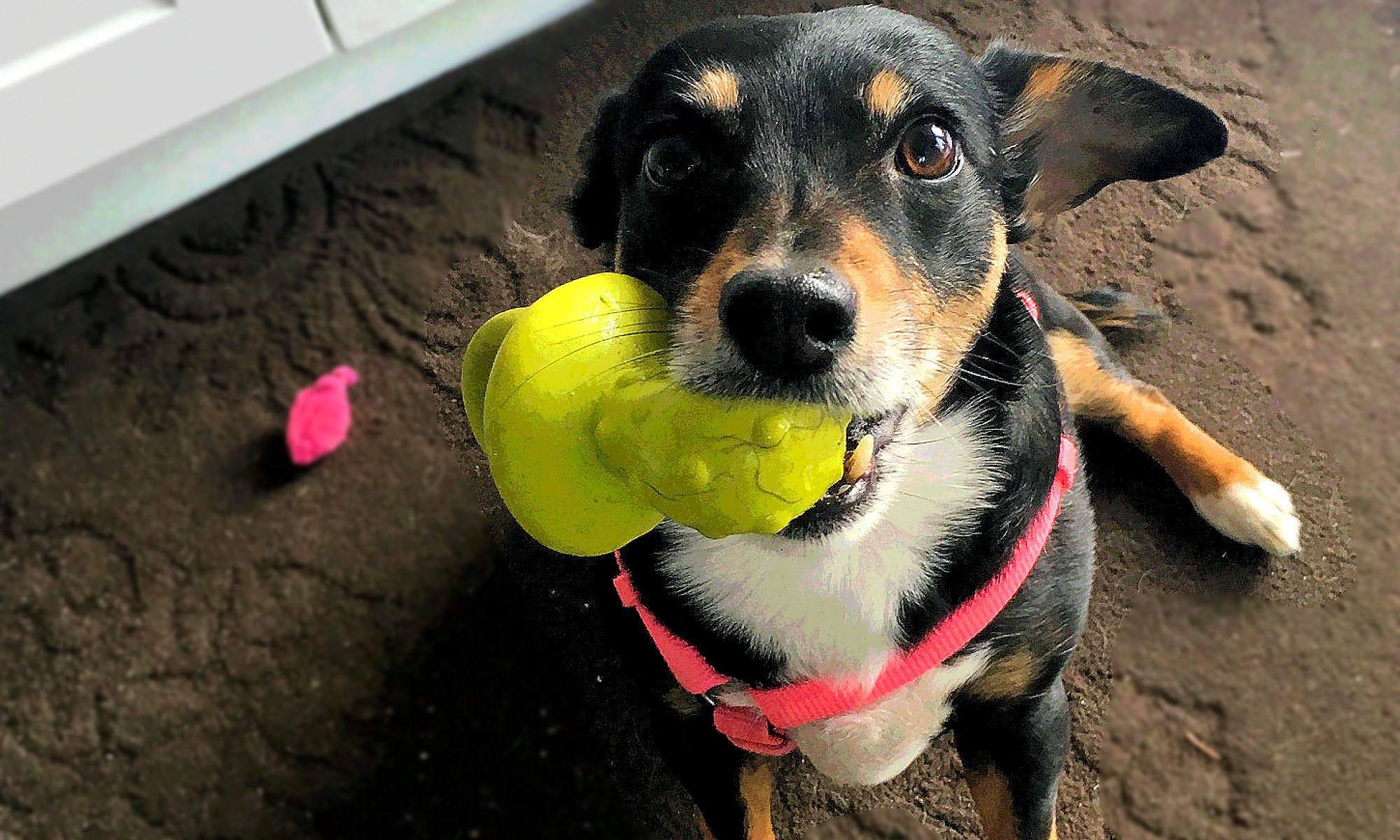 Bella started pacing indoors, going round and round and round in the same circular pattern, sometimes for hours. On walks outdoors, she stopped recognizing dogs she had known for years and hung back from greeting them. She didn’t want to greet people either, and shyed away from their outstretched hands. She couldn’t be let off a leash outdoors because she would wander — and sometimes run — away, oblivious to traffic or our frantic calls. She would often stumble and fall trying to climb the few stairs onto the front deck. And she became increasingly incontinent indoors. Sometimes she would just stand and stare at a wall or piece of furniture as if unsure what it was. **
It became clear she had cognitive issues. We have done our best to mitigate them and make her comfortable. We had to close the door to the basement because she could wander onto the stairs and fall down them. She stopped eating dry food, and we changed to an all-moist diet. Sometimes she eats; sometimes she just looks at her food and wanders away. When she does eat, she drops a lot of food from her mouth onto the floor around her, as a baby does. And sometimes she later walks through those pieces, seemingly oblivious to them.
She mostly stopped eating her favourite treats, too (treats before bedtime were once a ritual she has since forgotten), although sometimes she still seems to like a few. She sometimes struggles, becoming frantic to avoid a harness or collar when we want to take her out, and we try to calm her while we put it on. It’s as if she no longer knows the rituals for walking. She doesn’t like being picked up or brushed. Trimming her nails is very difficult.
We put up baby gates to confine her to the dining room, hall, and kitchen at night (a bit more than half the main floor). But increasingly she would soil (pee and usually poop) indoors at night. Then she would walk through it over and over, spreading it everywhere. Most mornings involved an hour or more of cleaning up, mopping floors, spraying disinfectant and odour removers. We recently reduced the space to one small hall and the laundry room, both with tile floors that are easier to clean, but large enough for her to move around freely. We spread training pads over the floor, too, to reduce the work of cleaning. But now, it seems she soils in her sleep, in her bed; any morning that happens, we have to clean that and wash it, too.
Her behaviour is erratic enough that now, when we go shopping or to appointments, even if we are only gone an hour or so, we have to pen her in that space because we cannot predict what she will do on her own, and don’t want to have to do a major cleanup when we return. We spend a lot of time watching Bella, trying to assess her for signs she needs to go outside, or has another issue. Most of the time we can only guess what she needs.
Dogs get dementia just like humans, and they behave like humans with Alzheimer’s when they have it. The Royal Canin website notes, “Canine cognitive dysfunction (CCD) is a form of dementia affecting geriatric dogs,” adding, “Canine dementia is becoming more common as our pet population ages … between 22.5-68% of elderly dogs express at least one sign of cognitive dysfunction.” It further notes that “CCD is a progressive disease and so further signs are commonly reported over time.” CCD, like its human forms, cannot be cured, only managed, and that involves a mix of medications, exercise, and behavioural adaptations. Aside from the medications (expensive!), we have done what we can in the other areas. ***
Frankly, we are at a loss. Bella is physically in good shape for her age: she goes for long walks, she shows no signs of serious arthritis or other mobility problems. She eats well, drinks water, and mostly has normal bowel movements. But she isn’t the same dog; she doesn’t always seem to know us, and she doesn’t behave as she did in the past (she shows little to no affection to us). She is a stranger to us now; an animal in our care, but not a pet. That’s deeply saddening, but also stressful, frustrating, and highly disruptive.
This is breaking our hearts. Our own sleep is being disrupted nightly (not good for seniors at any time, but potentially a serious health issue). Tempers can flare at the constant inconvenience, surveillance, and excess work required. We don’t know what else to do, or how long we can manage her. We love her, or rather we love what she used to be, and that memory helps us carry on. But we are equally saddened by the loss of that other dog, the one that stole our hearts.
Notes:
* While she stopped barking, sometimes at night she makes an unsettling moan or cry. The first time we heard it, we thought it was one of our cats. It was similar to the sound a cat in heat makes; nothing at all dog-like. We quickly learned it was Bella, crying. At being penned in? Or perhaps she’s alerting us she needed to go out to relieve herself. When I hear it, I quickly get up and get dressed so I can take her outside if she needs to relieve herself (hoping to be fast enough). Sometimes she doesn’t do anything outside and just wanders in the dark. The day I wrote this, we both got up about 1:30 a.m., and again about 3:30 a.m. in response to her crying. I took her outside into the snow every time. I got up myself again at 4:45 a.m. when I heard her a third time. She went back to sleep after each episode. In two of those times, she peed outside, but not all three.
** When Bella and we are awake in the house, we try to recognize the signs that she needs to relieve herself. Sometimes she paces faster, seemingly anxious, and stops to stare outside through the windows at the front or back door. That might mean she needs to go outside, but not always. I take her out when I see that behaviour, but most of the time, she just wanders around the streets and sidewalks, doing nothing more than sniffing. Other times she seems calm and then soils inside with no indication of distress. We take her outside to let her relieve herself numerous times a day, including at least three times in the evening after dinner.
*** The Royal Canin site has three acronyms for cognitive impairment: DISHA , DISHAA, and DISHAAL, which stand for various symptoms: Disorientation, Interactions (altered in relation to social stimuli), Sleep/wake changes, House soiling, Activity level alterations, Anxiety or apathy, and Learning. Bella has pretty much all of those symptoms in varying degrees.
Words: 1,640


- The Dementia Dog - 2026-11-24
- What Deranged Dictator Trump Might Do Next - 2026-11-05
- Thank You, USian Voters - 2026-11-05
