
Writers and reading

Loading

This post is about, and for writers, for reporters and editors, for book authors and editors, magazine editors, feature writers, layout artists, copy editors and anyone who either fancies themselves one of these, or has the curious desire to become one (curious because, at least for freelancers, it often involves spending more money on books than you get in income…). If you aren’t in that company, you should probably read something else, maybe just watch TV, because it’s going to be boring and a little pedantic. It’s about the books writers and editors read – or should read – to ……… click below for more ↓
Montaigne and The Block

Loading

I do love reading Michel de Montaigne.  And writing about him. In 2014 alone, I wrote ten separate posts about him and his famous book, Essays. But since then, my reading habits moved on to other writers and topics. I hadn’t actually been reading Montaigne in the past few years, but recently while sorting some of my books, I found him again. I started re-reading the Essays last week (and reading his travel journal, included in the Everyman edition – Frame translation, which I had not read previously). He is such an inspiration at times. Witty, observant, genteel, curious, passionate, ……… click below for more ↓

The work of politics

Loading

Politics is like many other skills, jobs and pastimes in that it requires work to succeed. Hard work, sometimes, for some folk, and easy for others, but always it requires attention, study, and focus. It isn’t something you can do when you’re not paying attention or even when you’re napping at the table (no matter what our own somnambulant councillor thinks… or more likely, doesn’t think at all). It isn’t something you can do effectively if, like our Block, you try to do it casually, or part-time, or whenever you feel like doing it, without paying attention or without effort. ……… click below for more ↓

The symphony of government

Loading

A good government in operation is like a symphony: disparate parts, dozens of different instruments and performers, each in their own space and place, all working together under the benign management of a conductor. When working in harmony, they are a delight to hear and see. There’s no “me” in a symphony: it’s the result of a remarkably efficient collaboration and trust of everyone involved. To be good, to sound good, they all have to watch the baton, to play and move in syncopation and in harmony. They all need to be tuned to the same pitch (A440). Singers need ……… click below for more ↓

The Dude, the Tao and the Dharma

Loading

I suppose it all began with Benjamin Hoff. Hoff was one of the first contemporary writers to attempt to distill Taoism in a lighthearted form for Westerners when he wrote The Tao of Pooh in 1981, a very successful book still in print. It was on the New York Times bestseller list for 49 weeks. A decade later, he followed with The Te of Piglet, less successful (its message somewhat diluted by Hoff’s extraneous political and social commentary) but also still in print. Not that Hoff was the first Westerner to attempt to explain Asian philosophy and religion. That goes ……… click below for more ↓

Thrasymachus and The Block

Loading

There’s a character in Plato’s Republic called Thrasymachus who acts as a foil to Socrates by presenting a series of comments and arguments the old philosopher has to debate and counter. He (Thrasymachus) is based on an actual historical figure, a Sophist from the fifth century BCE. It’s unknown if the views Plato has him voice are those of the real person, or simply a literary device to advance Socrates’ (and thus Plato’s) arguments. Of late, I’ve been reading Alan Bloom’s translation of The Republic. At the same time, I’m listening to the Great Courses 36-lecture series on Why Evil ……… click below for more ↓

Marcus Aurelius and The Block

Loading

Perhaps the most famous work by any Stoic is the Meditations, written as a series of notes-to-myself by Roman emperor Marcus Aurelius.  I’ve been reading a lot of Stoic works of late, and this remains my favourite. Although never meant for publication, just as reminders to himself, it’s full of wonderful, inspiring comments. And some seem eerily prescient in our current municipal calamity. For example, Book Two opens with these words: Begin the morning by saying to yourself, I shall meet with the busybody, the ungrateful, arrogant, deceitful, envious, unsocial. All these things happen to them by reason of their ……… click below for more ↓

The strange life of Bobby Fischer

Loading

Forty five years ago this month, a momentous event took place in Iceland that shook the world. After 21 games spread over almost two months, the eccentric American chess master, Bobby Fischer, ended 24 years of Soviet dominance in chess after beating Soviet grandmaster, Boris Spassky. It shook the world at the apex of the Cold War. I watched it unfold, a memory I will always  carry. Many years later, former Russian grandmaster, Garry Kasparov, commented, …in the Soviet Union, chess was treated by the Soviet authorities as a very important and useful ideological tool to demonstrate the intellectual superiority ……… click below for more ↓

Square words

Loading

Writing has been described as the most significant human invention. We tend to think of inventions as mechanical things, like the wheel, or fire, or the printing press, the airplane, the internal combustion engine or cell phone. But without writing, few of them would exist. Writing allowed us to share the others, to improve them, to record them, to pass them along and record them. Writing allows us to share ideas, emotions, visions, beliefs, stories, poetry and music through a series of abstract squiggles. Without writing there would be no literature, no religion, no philosophy, no songs, no politics. We ……… click below for more ↓

Assholes part two: Trump and his local mimics

Loading

Back in 2014 I reviewed a book by philosophy professor Aaron James called Assholes. A Theory. I discussed how his study related to politics and politicians, particularly those who call themselves “A-type” personalities (including one or two on the local council). Well James wrote another book, really an addendum to this one, titled Assholes. A Theory of Donald Trump. It was smaller than your average paperback, and a mere 130 pages, perhaps 20,000 words long. And since it came out just before the 2016 presidential election, it really doesn’t deal with the startling number of asshole things – the many, ……… click below for more ↓

Albert and the Lion

Loading

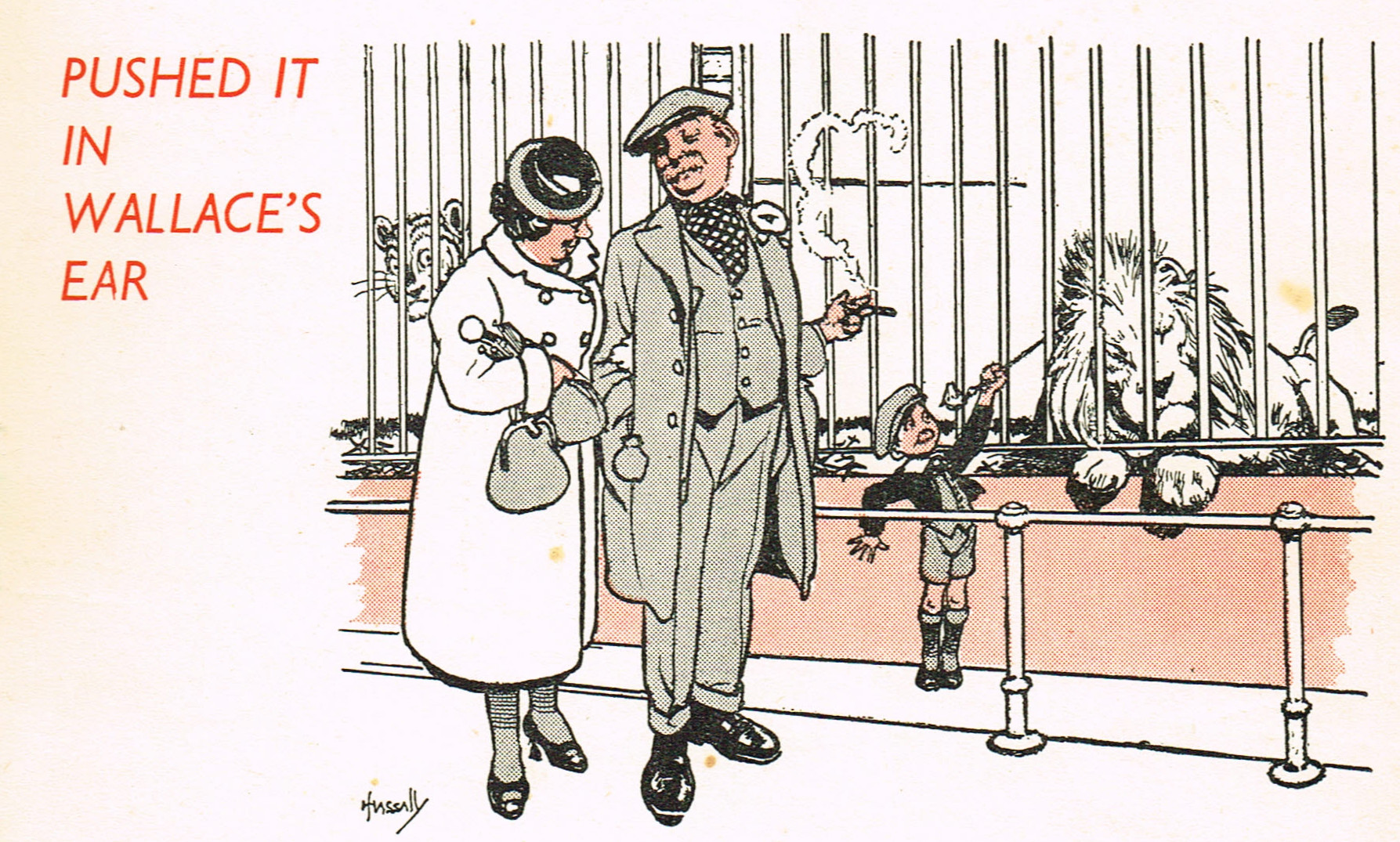
There’s a famous seaside place called Blackpool, That’s noted for fresh-air and fun, And Mr and Mrs Ramsbottom Went there with young Albert, their son. A grand little lad was their Albert All dressed in his best; quite a swell ‘E’d a stick with an ‘orse’s ‘ead ‘andle The finest that Woolworth’s could sell. So begins the poem, The Lion and Albert, written by Marriott Edgar. I first read it in the book pictured on the right: a book that accompanied a collection of 78 rpm records in which Stanley Holloway read the poems (click to see a larger image). ……… click below for more ↓

Three, six, seven, nine… how many basic plots?

Loading

When I was in school, back in the last century, I was taught there were three basic plots in which every story ever written could be classified: Man-vs-man, man-vs-nature and man-vs-himself. That was in the days when it wasn’t politically incorrect to use the word man to mean everyone. Today we’d say it differently, use other pronouns, but the meaning is the same. Three is a bit simplistic, sure. The list has been expanded on by authors, academics and critics ever since. And by robots, too. Last summer, a story in The Atlantic told of university researchers who used software ……… click below for more ↓

Book collecting: snobbery or reading passion?

Loading

The book has always been a sign of status and refinement; a declaration of self-worth – even for those who hate to read. That’s the lead into a recent piece on Aeon Magazine about book collecting and collectors. It’s also about reading and the snobbery of readers. Fascinating piece. For me, anyway. Pretty much everything about books and reading fascinates me, from the art to the industry to the neuroscience. I am and always have been a book buyer, proudly taking my place among those “Bookish Fools” referenced in the article’s title. But perhaps from a different part of the ……… click below for more ↓

The hospital, the trolley and political ethics

Loading

In its decision about the redevelopment of the Collingwood General & Marine Hospital, Collingwood Council is evidently taking the track less travelled, trolleyology-wise. Seen as an ethical issue, our council has chosen to act against the greater good. Trolleyology is the somewhat humourous name given to philosophical intellectual exercises or thought problems about our ethics and ethical choices. As Wikipedia describes it, the basic problem (and there are many, many variants) is simple: There is a runaway trolley barreling down the railway tracks. Ahead, on the tracks, there are five people tied up and unable to move. The trolley is ……… click below for more ↓

The dystopian present

Loading

If there is one good thing to come out of the election of Donald Trump, it has been the renewed interest in a certain genre of literature. Sales of dystopian novels have skyrocketed on Amazon, in particular what might be called “The Big Three” of dystopian tales: George Orwell’s 1984, Aldous Huxley’s Brave New World, and Margaret Atwood’s Handmaid’s Tale. From each of these novels, allegorical threads can be woven into some narrative aspect as a metaphor for the Trump administration: 1984’s newspeak, media manipulation and paranoid Big Brother; Brave New World’s elites-vs-savages mentality, exiled intellectuals and its psychological manipulation; ……… click below for more ↓

Back to Top